From Singapore to Norway, there are plenty of reasons to plan your next trip around a fabulous hotel opening its doors next year.


Here are 11 of them.

The Reverie Saigon (Ho Chi Minh City, Vietnam)

Opening: January 2015

Part of the new Times Square building in Ho Chi Minh City's District 1, this lavish lodging doesn't cut corners.

The 286 rooms and suites have been fitted out by four of Italy's finest interior designers and come with elaborate chandeliers, jeweled beds and velvet curtains.

Cantonese food is dished up by a Michelin-starred chef, there's traditional Italian in a dining room named after Romeo and Juliet (R&J), a deli and one of the longest bar counters in HCMC (reportedly the length of a city block).

You can arrive in one of the property's fleet of Rolls-Royce Phantom Dragons or, if you're short for time, chopper in -- the hotel has its own helipad.

Mama Shelter (Los Angeles)

Opening: February 2015

Philippe Starck may have been responsible for the design of existing properties in the Mama Shelter portfolio, but the French interiors celebrity passes the baton to Thierry Gaugain for the brand's Los Angeles property.

Located in a 1923 building and one-time hotel in Hollywood (supposedly a favorite of Jimi Hendrix and Eva Gardner) the property's 70 rooms will feature the same design flair of sister properties across France and Turkey.

Unfortunately, we'll have to take the company's word for it -- no photos have yet been released of the secretive new property.

In addition to a ground-floor restaurant and bar, the hotel will offer dining and drinks on a rooftop patio.

From here you'll enjoy unbroken vistas of the nightlife along Cahuenga Boulevard, the Hollywood ArcLight (one of the largest movie theaters in the city), Amoeba Music and, every Sunday, the Hollywood Farmers' Market, which is a block away on Selma and Ivar.

Lizard Island (Great Barrier Reef, Australia)

Opening: March 1, 2014

Cyclone Ita devastated this petite Great Barrier Reef island when it hit in April 2014.

Almost 12 months down the track, and following a massive rebuild and remodeling effort, the isle and its resort have set a re-opening date.

From March, guests will have access to Lizard Island's understated, barefoot luxury once more, with new resort additions including a standalone two-bedroom suite, The Villa, which comes with its own plunge pool, wraparound deck, and views of the Coral Sea.

The Pavilion now features a separate lounge offering ocean vistas, and the Sunset Point Villas now have more plunge pools.

Inside are design nods to the reef, with an earth-tones palette complemented by pops of coral, blue and gold.

A dedicated wine and cheese room has been added and the island's spa has been relocated and expanded to include a dedicated manicure and pedicure room.

One thing that hasn't changed is the spectacular diving and snorkeling, with some of the world's most dazzling marine life steps from your room.

Park Hyatt Zanzibar (Tanzania)

Opening: March 2015

The UNESCO World Heritage-listed Stone Town, the historic heart of the East African island of Zanzibar, offers a dramatic backdrop for the soon-to-open Park Hyatt Zanzibar.

The rich culture and heritage of this Tanzanian island -- an important trading hub for spices during the 19th century -- is reflected in the hotel's design, with its 67 rooms spread over two buildings.

One of them is the 17th-century Mambo Msiige, a beautiful Zanzibari mansion enveloping a peaceful courtyard and featuring intricate carvings.

Oceanfront rooms and suites offer shimmering views of Dhow Harbour and the Indian Ocean, a view also found from the beach-side infinity pool.

Other diversions range from an Anantara Spa to Zamani Residence, the hotel's restaurant designed to pay homage to a traditional family residence by allowing guests to enjoy meals in different areas, including a library with a veranda, the living room and the main dining room, with a terrace and residential-style kitchen.

Park Hyatt Zanzibar, Shangani Street, Stone Town, Zanzibar, Tanzania; +255 24 223 1234

Anantara Tangalle Resort & Spa (Tangalle, Sri Lanka)

Opening: mid-2015

One of two Anantara hotels opening on Sri Lanka's picturesque southern coast in 2015 (the other being the Anantara Kalutara Resort & Spa, welcoming guests from late 2015), Tangalle Resort & Spa sprawls over 18 hectares in Tangalle, a beach-side town around 80 kilometers east of the historic fortified city of Galle, and within easy reach of several national parks.

Design is inspired by traditional Sri Lankan architecture, with high-pitched thatched roofs, local artwork and artifacts, hand-carved furniture and plenty of breezy open spaces dotting groves of coconut palms.

The 152 guest rooms include 32 pool villas, which the hotel is billing as being the first of their kind in the country.

Facilities include a selection of restaurants and bars and an Anantara Spa.

Residences will be on offer for those who want to truly make the resort a home away from home.

Patina, Capitol Singapore

Opening: mid-2015

Patina Hotels & Resorts' flagship hotel is spectacular.

The brainchild of Singapore's Kwee family -- who also own the city's Capella, Conrad, Regent and Ritz-Carlton hotels -- the Patina occupies two heritage-listed buildings: the Capitol Building and Stamford House.

Part of a bigger redevelopment project transforming the old Capitol Movie Theatre, the 157-room hotel has two huge names attached to it: Pritzker Prize-winner Richard Meier and notable interior design company Jaya International Design, which conceptualized the beautifully laid out accommodations, including Wellness Suites and Art Suites.

Other features range from a library-lounge and saltwater relaxation pool to a state of the art fitness center and signature restaurant and bar.

Patina staff double as concierges -- a concept designed to tap into the creative skills of employees and have them provide personal experiences for guests.

Four Seasons Hotel Seoul (South Korea)

Opening: mid-2015

South Korea's first Four Seasons hotel will blend traditional designs with ultra-modern trimmings.

Occupying a new 25-story building in the CBD of Jong-gu, the hotel stands out for its prime location.

Adjacent to Gwanghwamun, the main gate of Gyeongbok Palace and the historic districts of Jong-ro and Isadong, the Four Seasons is a great base from which to explore the Korean capital.

The 317 rooms and suites showcase an earthy fusion of blonde wood, marble and local ceramics.

Facilities include restaurants and saltwater pool.

Meanwhile, another Four Seasons property is set to debut in the Moroccan city of Casablanca mid-year.

Alila Seminyak (Indonesia)

Opening: Q2 2015

It turns out there's room to squeeze yet another hotel onto Bali.

The latest luxury lodgings come courtesy of the Alila hotels group, which has four existing properties across the Indonesian island.

This newcomer sits on a beach along Bali's southwest coast, a short walk from the bars, restaurants and busy shopping streets of Seminyak.

Rooms and suites ring a pool -- one of three at the hotel -- that leads to the beach.

An 811-square-meter penthouse comes with its own infinity pool and terrace, as well as three bedrooms, a living room and kitchen.

Like other Alila properties, there's a strong environmental focus: buildings are laced with vertical rooftop gardens and green corridors link the four buildings.

Recycled and reclaimed building materials are used throughout and rainwater harvesting and solar energy are employed to reduce the hotel's environmental footprint.

SLS Park Avenue (New York)

Opening: late 2015

The third hotel in the SLS portfolio, joining properties in LA and South Beach, SLS Park Avenue has a perch that's hard to beat.

Located at 444 Park Avenue in Manhattan's trendy NoMad neighborhood, it's a couple blocks from Central Park and the Museum of Modern Art.

A celebrated creative team is behind the project, including visionary designer Philippe Starck, who was responsible for conceptualizing the 190 guest rooms and suites as well as a handful of restaurants and bars spanning the lobby and rooftop.

While the design concept is yet to be announced, from what we've seen of the property it's clear that Starck is bringing his signature whimsy to the project, which includes a glamorous blend of gilding and mirrors and a moody color scheme with plenty of designer furniture.

Lofoten Opera Hotel (Norway)

Opening: late 2015

The Lofoten archipelago is a dramatic union of soaring peaks, untouched beaches and sheltered bays.

It's here that you'll soon find the Lofoten Opera Hotel, a property befitting its wild surroundings.

Design firm Snohetta is behind the eye-catching building that cascades toward the sea and links the mountains and ocean.

In addition to hotel rooms -- all of which will offer unbroken views thanks to the hotel's circular design -- the 11,000-square-meter site will be home to apartments, an amphitheater and spa.

It's a far-flung corner of the world, but that's part of the appeal.

The surrounding wilderness offers treks, kayaking and sailing, among other activities.
Ritz-Carlton, Langkawi (Malaysia)

Opening: 2015

Fringed by tropical rainforest, the Ritz-Carlton, Langkawi enjoys a private cove and beach overlooking the Andaman Sea on the island's southwest corner.
Next year's big hotel trends

The 132-room resort, including 42 villas, nods to traditional architecture: buildings reflect kampong village styles and classic interiorsl.

The family-friendly property features three swimming pools, including one just for children, and there's also a Ritz Kids Club.

While staff look after your young ones you can head to the spa, replete with a Turkish-style hammam.

Restaurants reflect the diversity of local culture, with Malay, Chinese, Thai and Indian offerings -- plus French fine dining and an international beach grill.

Not sure where to go on vacation next year?

To help get you motivated, we've identified 10 destinations that are sure to make headlines in 2015.

Some will host major global events, while others will celebrate anniversaries, unveil new attractions or stand in Mother Nature's spotlight.

The Bahamian Riviera

With four hotels, 200,000 square feet of convention space, a 2,000-seat performing arts center, 18-hole Jack Nicklaus Signature golf course, 30 restaurants and bars, 14 distinct pools and a 100,000-square-foot casino large enough to rival any in Las Vegas or Macau, the $3.5 billion development known as Baha Mar is kind of a big deal.

In fact, the so-called "Bahamian Riviera" is the largest single-phase luxury resort project in the history of the Caribbean and the most substantial currently in development in the Western Hemisphere.

Located along Nassau's famed Cable Beach, Baha Mar is expected to send ripples across the Caribbean when it opens to the public in late spring 2015 with a grand gala produced by music and entertainment legends Jamie King and Emilio Estefan.

The event is meant to herald the arrival of a new Riviera -- one full of 21st-century entertainment located right in Florida's backyard.

Mons, Belgium

Mons, Belgium, has a population of just 93,072 people, but the small city expects 2 million visitors to ply its medieval streets when it hosts more than 1,000 cultural and artistic events in 2015 as the offical European Capital of Culture.

Highlights of the yearlong celebration include an illuminating new Van Gogh exhibit, three multidisciplinary arts festivals, numerous public installations and art-infused parties.

Moreover, Mons will unveil not one, not two, but an astounding five new museums in April, including The Artotheque (art library) and Mons Memorial Museum.

Think of 2015 as a coming out party for this former mining and industrial center that's completely reinventing itself.

Downtown Los Angeles

A decade ago, you'd have struggled to find life on the streets of downtown Los Angeles after the office lights went dim for the night.

But what was once the city's dark center has rapidly transformed into one of its most exciting neighborhoods, with more than 500 shops, restaurants, bars and clubs opening their doors in the past five years alone.

Exciting new hotels like the Ace, stores like Acne Studios and food venues like the revamped Grand Central Market -- in addition to the recently completed $3 billion sports and entertainment complex known as L.A. Live -- have injected downtown with a jolt of energy that's helped lure visitors and residents away from LA's sunny perimeter and into its urban core.

The downtown scene is expected to heat up in 2015 when billionaire art collector Eli Broad's $140 million vanity project, theBroad Museum, opens to the public in the fall.

The honeycomb-encased gallery has been heralded as the crowning jewel of downtown LA's revival, and will house works by some of the most prominent artists of recent decades, including Jeff Koons, Roy Lichtenstein and Cindy Sherman.

Faroe Islands

The Faroe Islands have never really had their moment in the spotlight, but a dance with darkness in 2015 may finally put the remote archipelago between Norway and Iceland on travelers' radars.

This self-governing country within the Danish Realm is one of just two places in the world that will witness a total solar eclipse on March 20, 2015, when the moon passes between the earth and sun, plunging daylight into darkness.

Several travel agencies are already filling up tours and cruises to the storybook isles for this once in a lifetime astronomical event.

Though it'll last just 2 minutes and 47 seconds, Europeans won't see anything like it again until 2026.

Coober Pedy, Australia

Alice Springs and Uluru (Ayer's Rock) have long served as the two pinnacles of Outback Australia's tourism duopoly, but an increasing number of visitors are venturing further south along the Stuart Highway to explore the "underground town" of Coober Pedy, where 80% of the world's opal comes from.

Coober Pedy will celebrate its Centenary in 2015 with a year's worth of events, including an opal festival, gem show, marathon, dances and street parties.

Tourists heading into town for the celebrations will have the opportunity to sleep as the locals do in subterranean dugouts that promise a consistent temperature of 25 C (77 F).

There will, perhaps, be nowhere else on earth in 2015 where you can shop for bargain-basement gems, march in a street parade and retire to your underground hotel room ... all in one day.

Singapore

Singapore has a reputation for being pretty and dull in equal measure.

However, the undeniably attractive isle of Singapore will be anything but boring in 2015 as it celebrates 50 years of independence with fireworks, parades, shows, youth rallies and a new walkway from the Civic District to Marina Bay.

Yet, Singapore's Golden Jubilee isn't the only reason to visit in 2015.

The long-awaited National Gallery will finally open to the public in November and join recently unveiled attractions like River Safari and the massive Singapore Sports Hub in diversifying the city's offerings.

Salta, Argentina

What if you could visit the Grand Canyon and Napa Valley within the course of one afternoon?

That, in essence, is what's on offer in Salta Province, a dusty patch of Andean Argentina where the country bumps up against Bolivia, Chile and Paraguay.

Salta is home to colorful colonial towns, gnarled mountainscapes and the highest altitude wineries in the world.

With a $160 million plan underway to turn this largely domestic destination into the eco-tourism capital of Latin America, this is a cat that's about to be let out of the bag.

If you like your wine with a side of adventure -- and want to take advantage of Argentina's exceedingly favorable "blue dollar" exchange rate -- Salta will be ready and waiting in 2015.

Milan

The World's Fair has left the planet with many icons -- the Eiffel Tower, the Space Needle, the first Ferris wheel -- but the legacy of Expo Milano 2015 will likely be in the ideas it generates, rather than any architectural marvels.

Travelers from around the world are expected to converge on Italy's second-largest city between May and October to ruminate on the future of food within a 1.1 million-square-meter fairgrounds plotted out like a classical Roman metropolis.

The event promises to put participants from more than 140 counties in touch with an estimated 20 million visitors across 60 pavilions, a record number exceeding even the 2010 World's Fair in Shanghai.

Expect exotic food tastings, educational lectures and rich, multi-sensory experiences.

Mekong and Irrawaddy rivers

Small cruise vessels have long been a staple of European rivers, but with river cruising ballooning into the fastest-growing segment of the travel industry (according to industry reports), many boats will find new homes in 2015 along two of Southeast Asia's most important waterways: the Mekong and Irrawaddy rivers.

More than a dozen new ships from a half-dozen companies (including Viking, Haimark and Avalon Waterways) will set sail in 2015 on journeys through Myanmar or across the Vietnam-Cambodia border from Ho Chi Minh City to Siem Reap.

For those who always wanted to see Southeast Asia, but didn't want to deal with the hassle of tuk-tuks and touts, there's never been an easier (or more comfortable) way.

Abu Dhabi

Dubai may have exploded into a theme park of superlatives, but its oil-rich neighbor Abu Dhabi has steered a different course in a multibillion-dollar bid to become the cultural capital of the Middle East.

At the heart of Abu Dhabi's reinvention is the 24,000-square-meterSaadiyat Island Cultural District.

This intellectual playground is set to house the Guggenheim Abu Dhabi in 2017, the Zayed National Museum in 2016 and, if all goes according to plan, the first Louvre Museum outside Paris by the end of next year.

Add to the mix a performing arts center designed by Zaha Hadid, and it's clear that both the skyline and city below are about to get a lot more inspiring.

For its vertical limestone cliffs and unspoiled sea views, Ireland’s dramatic western coastline may get top billing. But visitors to Dublin hoping to catch a glimpse of the rugged beauty of the Emerald Isle needn’t spend extra hours and expense traveling west. For little more than the cost of a pint, they can hop on Dublin Area Rapid Transit, or DART, the city’s electric rail network that winds roughly 30 miles along the eastern coastline, for convenient under-an-hour escapes. The following day trips — whose draws include staggeringly scenic sea cliffs that are destinations in their own right, a James Joyce museum and, no surprise, excellent seafood and beer — promise memorable, and frugal, additions to any Dublin vacation. (Factor in maximum prices for “the Dort,” the Dublin Bus, and the Luas light rail tram system — at 10 euros a day, $12.20 at $1.22 to the euro, or 40 euros a week — and travel costs become even cheaper.) And while wintertime daily highs average in the mid-40s, confining swimming to only the hardiest souls, with views like these, who needs a dip in the ocean?
Sandycove

About 30 minutes by DART from central Dublin (6 euros for a round-trip ticket, or 4.82 euros when purchased with a prepaid Leap card), the village of Sandycove has one pub, one bistro and little more than a handful of other storefronts. Its main lure is the sea, most notably at the Forty Foot, a (free) bathing spot set among a promontory of rocky outcroppings, with its “Gentlemens Bathing Place” metal sign still intact, though no longer enforced. It is popular year-round — especially on Christmas Day, when hundreds of swimmers line up along its stone steps to plunge into the icy waters in what has become an annual tradition.

On the chilly autumn afternoon I visited, I watched a steady stream of seasoned bathers peel off their jackets and sweaters to bathe in the frigid sea, among them Caineach Brady, a 67-year-old Dublin priest who said he swims two to three times a week at the Forty Foot through winter. “It’s absolutely wonderful, the sea against skin,” Father Brady said. I got my feet wet, but demurred at the thought of a full dip, and instead soaked in views of the sea and the sprightly swimmers.

Sandycove’s other main attraction, just beyond the Forty Foot, is the stone Martello tower where James Joyce had stayed for six fateful nights when he was 22, and provided the setting for the opening scene of “Ulysses.” After a six-month renovation, the James Joyce Tower and Museum (free admission) reopened in April. I pored over a small, captivating collection on the first floor that contained various first editions and other rare books that included a 1935 printing of “Ulysses” with illustrations by Henri Matisse, and a hodgepodge assortment of Joyce’s possessions: a guitar, a leather cabin trunk, a checkered tie he gave to Samuel Beckett, and his last cane.
Continue reading the main story

But it was when I left the first floor that things got more intimate. I climbed my way up an extremely narrow, winding set of very short stone steps — each was about half the length of my foot — and found myself in a re-creation of the “gloomy domed livingroom” Joyce had described in “Ulysses,” with an iron-framed single bed covered with a tattered blanket pushed up against one wall, and a hammock slung across a corner nearby. Up another set of tightly wound steps, and I was on the circular rooftop of the 40-foot tower, with superb views of the endless expanse of Dublin Bay.

“The snotgreen sea” was how the “Ulysses” character Buck Mulligan described it, but as I stood where he made his pronouncement, I couldn’t help but think that description was ungenerous. With waves crashing onto the sharp-edged gray rocks below, sea gulls squawking plaintively above and the heady smell of salt in the air, the turquoise-gray water before me felt meditative, mystical and potent.
Bray

Five stops south of Sandycove on the DART, and about 40 minutes from central Dublin (6.65 euros for a round-trip ticket, or 5.74 euros prepaid) lies the town of Bray, which in the mid-19th century had been one of the country’s largest seaside resorts. During a visit in late October, I found its beachfront — whose sandy stretch gives way to a wide swathe of gorgeously smooth, oval stone — calming and restorative, dotted with just the occasional kite flyer and dog walker, as well as another brave swimmer.

But I found real tranquillity when I ambled along the roughly four-mile Cliff Walk, a stunning coastline path hugging the side of the nearly 800-foot-high Bray Head that squashed my long-held belief that the more challenging a hike, the greater the payoff. The Cliff Walk has a gentle incline (less than 400 feet from bottom to top), picnic tables and benches generously scattered about for frequent rest breaks, and beautiful low stone walls and wire cliff railings in place for much of the path. In return, it affords views of strikingly scenic slate cliffs and Dublin Bay’s thousand shades of blue while winding past stretches of shoulder-height fern and patches of flowering yellow gorse. Out there, I found colors so sharp and vivid, it was as if they had been passed through a saturation filter.

The walk ends in the quaint town of Greystones, whose DART station marks the southern extent of the train line. I popped on a waiting train back to Bray (3.15 euros for a one-way ticket, or 2.41 euros prepaid) where I rested my legs and ordered a crisp flatbread loaded with shrimp, sweet red peppers and caramelized onion (9 euros) at the year-and-a-half-old Platform Pizza Bar, easily the most stylish — and eye-catching — restaurant in town, housed in what resembles a slate-gray shipping container across from Bray’s mile-long beachfront promenade.
Continue reading the main story

Revitalized, I went off to explore the town’s beer scene, starting first at thePorterhouse Bray, the original brewpub that belongs to one of Ireland’s earliest and largest microbreweries, which now has pubs in Dublin, London and New York. I parked myself in front of a roaring fireplace and sampled its super smooth Plain Porter (4.50 euros) followed by its Oyster Stout (4.50 euros), a spicy, bitter beer that takes its name from the fresh oysters used during preparation. Both came dark, cold and with luxuriously creamy heads.Continue reading the main story
RECENT COMMENTS

Milo 12 hours ago

The DART ride south is quite something for views and wildlife. I've seen porpoises jumping and though there are few cities in the world...
laq 12 hours ago

Dalkey Beach is beautiful too.
Paul Brady 12 hours ago

Can you remove the reference to the view over the Dublin Bay from Howth being among the best in the World? It's a secret.Just kidding!...
SEE ALL COMMENTS 
WRITE A COMMENT

I whiled away the rest of the evening at the nearly 150-year-old Harbour Bar, voted the “best bar in the world” in 2010 by Lonely Planet. It was also a haunt of Peter O’Toole, who gave it a giant moosehead decades before taxidermy-lined drinking dens came into (and went out of) vogue. It’s now a warren of cozy rooms brimming with bric-a-brac large and small — framed nautical knots, an Underwood typewriter, a rowboat — serving an excellent selection of beers like the beautifully nuanced amber ale from Wicklow Wolf (5.30 euros), a brewery just a five-minute walk away.
Howth

About 30 minutes on the DART from central Dublin (6 euros for a round-trip ticket, or 4.82 euros prepaid), Howth has a distinctly different mood from Bray: there’s a sandy beach, but it’s not visible from the center of town, unlike the working harbor. And compared with Bray’s Cliff Walk, the Howth Head walk, whose shortest loop runs 3.7 miles around the Howth Peninsula that juts into the Irish Sea, feels less cosseted and more raw.

In late October, when I attempted the walk, I wavered between feeling exhilarated and nerve-racked when the path wound dizzyingly close to the edge of the steep sea cliffs with their precipitous drops and noticeable absence of safety railings. (The misting rain didn’t help either, nor did the abundant “Dangerous Cliffs” signs.)

CONTINUE READING THE MAIN STORY11COMMENTS

But I continued on, and I’m glad I did. I passed fields of purple heather and brushed up against bright-green moss-covered stones. And when I approached the summit, I had to agree with H.G. Wells’s description in his 1918 novel “Joan and Peter” of the view from Howth Head as “one of the most beautiful views in the world.” Cliffs now seemed to drop gently into the sea, enveloped in cascading blankets of tawny-colored heathland before the white Baily Lighthouse, which stood at the peninsula’s tip. Shafts of light cut through the clouds, and across Dublin Bay, I made out the looming shapes of the Dublin and Wicklow Mountains.
Continue reading the main storyContinue reading the main story
Continue reading the main story

Elated by the view, I headed back to town, where I angled for a seat atCrabby Jo’s, a popular restaurant attached to the Wrights of Howth fish market, more than a century old. As I warmed myself with a bowl of seafood chowder (5.95 euros), I became convinced all chowders would benefit from the addition of smoked haddock, whose rich, salty flavor permeated the creamy version at Crabby Jo’s. I also ordered the open crab sandwich, two lumps of fresh-tasting Kilmore Quay crab tossed with diced apple and celery on a bed of arugula and shallots on dense, crumbly brown bread (9.95 euros).

On a warmer trip, picnic options along the edge of the water abound, including piping-hot fried hake with chips from Beshoff Bros. (8.95 euros), and a messier alternative in whole smoked mackerel with a loaf of bread from Nicky’s Plaice (5 euros, fish priced by weight), a no-frills fish market near the end of the Western Pier. But I was just as happy to be enjoying a nourishing meal in a spot perfect for a wintry Dublin getaway.

Until last year, Jenins (pop. 914), about an hour’s drive southeast of Zurich, seemed like any other small town in Switzerland’s verdantly lush Bündner Herrschaft wine-growing region, with sloping vineyards heavy with pinot noir grapes edging up onto trim houses lined with planters of bright geraniums. These days, though, there is one very noticeable new addition.

At the end of Verduonig, a quiet residential street, a small wooden sign that announced “museum” was the only indication of the anomaly to come: a grape-vine-covered stone and red-brick structure that seemed to jut from the earth like a large mound, with a round, green oak door with brass knob, and circular windows that looked onto a small garden of rose bushes.

As any fan of J. R. R. Tolkien would recognize, it was a Hobbit hole. The remarkable structure serves as the striking entrance to the Greisinger Museum, the world’s first museum dedicated to Tolkien’s fictional universe, Middle-earth.
Continue reading the main story
RELATED COVERAGE


Movie Review: ‘The Hobbit,’ Round 3, ‘The Battle of the Five Armies’DEC. 16, 2014

Opened in October 2013, the museum has seen about 3,000 visitors so far, with that number expected to rise with this month’s release of the final installment of Peter Jackson’s Hobbit trilogy, “The Hobbit: The Battle of the Five Armies.” The museum is the vision of Bernd Greisinger, a former fund manager who has amassed what is considered by many Tolkien experts to be the world’s largest trove of Middle-earth collectibles, with 3,500 books and 600 artworks including paintings and drawings by the noted Tolkien artists Douglas Beekman, Cor Blok and Alan Lee.

“It’s the only museum whose sole aim is the promotion of Tolkien, Tolkien’s works and subsequent adaptations,” said Shaun Gunner, chairman of the British-based fan club, the Tolkien Society. “There is an unrivaled collection of rare books and collectibles.”

The Greisinger Museum is no ordinary museum, but one teeming with eccentricities as it descends into a warren of unusual rooms two levels underground. For starters, the Hobbit hole’s archways are only five feet high — Hobbits are short creatures, after all. Visitors can also only view the collection through one of the two-hour guided tours, many of which are held by costumed guides, Mr. Greisinger included, in German, French or Italian. (While those languages are easier to interpret than Elvish, for sure, English tours are also available for groups of 10 or more; all tours must be booked in advance, 50 Swiss francs, about the same in dollars).

Perhaps the kookiest — and most wondrous — aspect of the 36,000-square-foot museum is that each of the additional 11 rooms besides the three-room Hobbit hole represents a different location in Tolkien’s fantasy world. Tours start in the Hobbit hole, whose furnishings include rustic hand-carved wooden chairs scattered around a fire­place and a large writing desk piled with maps of Middle-earth. “We want to give people the feeling that they’re in the right place, what it feels like to be inside a Hobbit hole,” Mr. Greisinger said.
Continue reading the main storyContinue reading the main story
Continue reading the main story

A number of collectibles are also in evidence, most notably a chandelier from Tolkien’s seaside bungalow in Poole, England, and the 1969 Ken Rudolph calendar, the first ever Tolkien fan art calendar, published with signed artwork by the Tolkien illustrator Tim Kirk.

But the Hobbit hole represents a mere scratching of the surface — literally — of the experiential museum. Its subsequent rooms are all intricately designed and unexpectedly unorthodox in shape and size: The Gondor room, spanning two floors with a spiral staircase, celebrates the great Middle-earth kingdom with white columned pillars; the Wilderland room displays two custom-built statues in the likeness of the Gates of Argonath; and a 13-foot-tall installation of a fearsome Balrog creature dominates the Moria room.

On my visit in late summer, Mr. Greisinger and I pored over a few of the 30 rare books on display, pausing to examine an inscription by Tolkien to his close friend Elaine Griffiths in an extremely rare first impression of a first edition of “The Lord of the Rings.” (The rest of the rare books collection can be seen by appointment.)

It is Mr. Greisinger’s fascination for Tolkien’s books that feeds his art collection.

“Our work is to find originals of the different illustrations in the books,” he said. While Mr. Greisinger acknowledges the Peter Jackson films with memorabilia that includes a smattering of props from the movies and a script of “The Lord of the Rings: The Fellowship of the Ring” signed by the cast members, he insists the films are not a focus of his museum.

“The Peter Jackson films are just one interpretation of Tolkien’s world,” he said. “My goal is to have visitors understand more of Tolkien’s world and all that is connected to it.”

At minus 37 degrees Celsius (that’s minus 35 Fahrenheit) on a cloudless February morning, most of Winnipeg, Manitoba, was quiet. But I wasn’t the only one who was defiantly laced into ice skates. Out on the Assiniboine River, commuters, dog walkers, stroller pushers, hockey players and general dawdlers were gliding along a smooth band of ice, steam clouds drifting from behind their scarves with every aerobic side-to-side stride. One couple succumbed to the cold, wrapping themselves in curtainlike wool blankets that were suspended from a bridge like a massive Hudson Bay comforter, which was precisely their purpose.

“Red Blanket,” designed by Toronto-based Workshop Architecture was one of 17 loosely termed “warming huts” stationed last year along Winnipeg’s Red River Mutual Trail, a four-mile trail that covers the intersecting Assiniboine and Red Rivers that meet in an area known as the Forks. Annually, the trail is plowed, groomed and Zamboni-ed into one of the longest skating trails in Canada, and perhaps its most distinctive, as it is dotted with architect-designed warming huts.

Forget customary cabins with roaring fireplaces or heat-belching furnaces. These huts more closely resemble art installations, and many, including my favorite, “Wind Catcher,” a Caribbean blue open-sided box with an orange wind funnel within, aren’t even warm. Six years ago, Peter Hargraves, a principal at Winnipeg-based Sputnik Architecture, was co-founder of an architectural contest to build inventive huts along the river rink.

“The project was selfish initially,” Mr. Hargraves said one afternoon last February as we skated the trail together. Without warming huts, he said, he’d be freezing before he finished tying the skate laces for his three children. Once he determined the city needed warming huts, the architect saw a unique opportunity.

“This is Winnipeg. We’re a winter city,” he said. “I thought, let’s enhance it.”

He created an architectural competition that has grown in the past six years from a local novelty to a global attraction. Designers from students to big-name architects have submitted entries, including Frank Gehry, whose 2012 contribution featured an igloo made of clear blocks of ice.

This year’s three winners, announced in November, drew from over 100 entries worldwide and include a shelter and two art installations. “The Hole Idea,” from Toronto-based Weiss Architecture & Urbanism, provides refuge in a 35-foot-long, 10-foot-diameter snow tunnel to be built in a riverside snowbank. Art installation winners include “This Big,” an ice sculpture of an enormous fish emerging from the frozen river from Dorebak Akershus in Norway. “Recycling Words” from Montreal-based Kanva Architecture stations 50 repurposed chairs, each bolted to recycled skis, along the trail. Stenciled with words like “flow” and “trade,” the portable chairs will serve resting skaters and can be rearranged to create phrases.
Continue reading the main story

Invited entries (those solicited but not judged) in the class of 2015 include the “Hybrid Hut,” an arching, ring-shaped shelter covered in recycled timber from Rojkind Arquitectos of Mexico City. Students from the University of Manitoba produced “Mirror Cloaking,” a box sided in one-way mirrors. Built in Winnipeg on 8-by-12-foot skids, the huts are hauled out onto the ice once it’s deemed solid enough, usually in January, and remain until the spring thaw, usually early March. The annual newcomers are erected along with some of the greatest hits from years past, including an overturned-canoe-shaped hut covered in pine boughs called “Fir Hut,” from the Nova Scotia architect Richard Kroeker. This year a total of 20 warming huts will be posted along the skating trail.

To tour the collection, as I did last winter, is akin to visiting an interactive sculpture garden on blades (the retail development at the rivers’ intersection, also known as the Forks, offers rental skates for 5 Canadian dollars, $4.45 at 1.12 Canadian dollars to the U.S. dollar). At “Hygge House,” a three-sided cabin in which interiors, exteriors and furnishings are painted neon green, I rested in a rocking chair next to a nonfunctioning stove and admired the taxidermy duck on the wall. At “Apparition,” designed by the Albuquerque-based architect Antoine Predock, who also did the city’s new Canadian Museum for Human Rights, I climbed into a snowbound metal cave. I couldn’t resist a selfie in the student-designed ceilingless “Skybox,” paneled in reflective materials from the University of Manitoba. (“Red Blanket,” “Fir Hut,” “Hygge House,” “Wind Catcher” and “Apparition” are again part of this year’s lineup).

The river route winds from the touristy Forks area out to residential neighborhoods. Beaten paths in the snow indicate access routes used by locals, who change into their skates at the warming huts, proving their practical purpose.

“We started installing the huts along the skating trail so you didn’t have to come to the Forks to access the river, but could go directly to the trail,” Mr. Hargraves said. “Effectively, it’s turned the river into a park. Before you mostly stayed off the river. You’d clear a rink, but with trepidation.”

Now the Forks center has taken on trail maintenance, including sending a Zamboni out daily to resurface the ice, and patching crews to fill holes. The result is one of the smoothest outdoor rinks I’ve experienced in a lifetime of shoveling them in northern Michigan. Now, over 20,000 people visit the Forks on winter Saturdays, though on weekdays, when I visited, there was plenty of room to race.
Continue reading the main story Continue reading the main story
Continue reading the main story

The popularity of the warming huts has inspired more pop-ups on the river, especially RAW:Almond, a restaurant built on the ice under a tarp-covered metal structure. (This year’s rendition is slightly more stylized; the pop-up held its own design competition for the structure.) For three weeks in late January and early February, the restaurant offers three dinner seatings nightly at its enormous 30-seat center table. I took a hide-covered tree-trunk stool at the table one night between two CBC radio broadcasters and a pair of doctors for a five-course meal overseen by Raw:Almond’s culinary mastermind, the chef Mandel Hitzer, who runs a restaurant called Deer + Almond on Winnipeg’s terra firma.

“The Forks has always been a meeting place,” said the chef, addressing diners before servers brought out the first course, tuna sashimi with shiso vinaigrette. “Over the centuries our city was built on these riverbanks. This is a way to sit on these frozen waters comfortably.”

Like Ice Capades for foodies, waiters and chefs slide around the ice dining room in rubber boots as they come and go with plates of food. Diners keep their parkas zipped and their stocking caps stuck firmly on their heads as they dig into shoyu-marinated duck breast and foie gras.

“Manitoba is so cold you have to do something to get people out of their homes,” said Thomas Fudge, a Winnipeg medical student who, with his wife, Jessica, dined next to me at the communal table. “We’re sitting on a chunk of ice in middle of river, and we’re happy about it.”

“Our winter is about building community,” Mr. Hitzer said, as I poked my head into the makeshift kitchen, its plywood walls graffitied in notes of appreciation including, “Thank you for making my winter a special event.”

President Obama’s order on Wednesday to restore diplomatic relations with Cuba after more than 50 years has many ramifications, including for travel.Many restrictions remain in place for Americans wanting to visit Cuba, but the order makes it easier for a number of prospective travelers.

Q. What impact will Wednesday’s announcement have on the number of Americans wanting to travel to Cuba?
Continue reading the main story
RELATED COVERAGE
graphic
How America’s Relationship With Cuba Will ChangeDEC. 17, 2014

A. It’s too early to tell. Many Americans clearly have a strong interest in traveling to Cuba. Citing Cuban government data, The Times reported on Dec. 2 that more than 90,000 Americans visited Cuba legally in 2012 and 2013 — more than twice the number that traveled (to Cuba) legally in 2008 — under people-to-people cultural exchanges. These exchanges, which require travelers to go with a licensed operator, were reinstituted by President Obama in 2011 to allow travel to Cuba for educational purposes, “not for down time on the beach,” said Steve Loucks, chief communications officer at the Plymouth, Minn.-based Travel Leaders Group.

Mr. Loucks said he anticipates demand for these exchanges to continue to increase, especially after Wednesday’s announcement. “We are already feeling a great deal of demand from clients wanting to go to Cuba, because it has been off limits for over 50 years,” he said. “We now expect the number of bookings to Cuba to grow exponentially.”

Q. Does this mean travel agencies will start organizing more trips to Cuba?

A. In some cases, yes. In fact, some were trying to meet increased demand before Wednesday’s announcement. Last week, Tauck, a tour operator based in Norwalk, Conn., extended its eight-day people-to-people cultural journey to Cuba to 13 days with stops in five cities.

“I think it’s a destination like no other,” said Katharine Bonner, vice president for river and small ship cruising at Tauck, who has taken five trips to Cuba in the last three years.

Joe Diaz, co-founder of the travel and publishing company Afar Media, said he agreed with that description. “It is really something out of the 1950s,” he said. “That’s what makes Cuba special."

Q. Will getting a passport/visa become easier?

A. Mr. Diaz said he thinks so. “But it seems like leisure and tourist travel are still prohibited,” he said. “We’ll have to wait and see what happens.”

This New York Times information graphic identifies the exceptions for United States citizens and permanent residents who want to travel to Cuba on a general license that require no special permission.
Continue reading the main storyContinue reading the main story
Continue reading the main story

President Obama’s order will open up general licenses to travel for the following reasons, which previously required approval on a case-by-case basis:

Public performances, workshops and athletic competitions.

Support for the Cuban people, including human rights work. Humanitarian work. Private foundations and institutes. Information dissemination.

Travel related to export of authorized products.

But lifting all restrictions on travel, including for tourism, would require congressional approval.

Q. Will United States airlines start flying commercially to Cuba?

A. Possibly, but don’t head to Kennedy International Airport or O’Hare International Airport any time soon and expect to hop a commercial flight to Havana. Commercial service from the United States to the Cuban capital is “going to be down the road,” Mr. Loucks said. “Many airlines are already flying between Miami and Havana, but it’s more of a charter service. It’s essentially ferrying family members back and forth along with those on people-to-people exchanges.”

Q. What is the hotel room/accommodation situation in Cuba now?

A. “There is a lot, but at the high end there are only a couple of good properties,” Mr. Diaz said. “People don’t go to Cuba for the luxury — they go for the music, culture and arts scene.”

But if Cuba opens up to American tourists and their penchant for luxury accommodations, “you’re going to see American hoteliers doing their best to find potential properties in Cuba,” Mr. Loucks said. “There are some standout properties there in Havana and some of the beach communities.”

Q. What will be the impact of travelers being able to use United States debit and credit cards in Cuba?

A: A positive one, Ms. Bonner said. “Being able to use credit cards will make it so much easier,” she said. “Right now you have to think in advance how much cash you need, and it can become quite an ordeal.”

The United States trade embargo is still in place, and will be until Congress says otherwise, but as a result of the administration’s policy shift, “licensed U.S. travelers to Cuba will be authorized to import $400 worth of goods from Cuba, of which no more than $100 can consist of tobacco products and alcohol combined,” the White House said. That’s good news for Cuban cigar and rum aficionados returning to the United States.

Q. What are other changes American visitors to Cuba can expect?

A. The administration has said it will re-establish a United States Embassy in Havana, which could be widely embraced by American tour operators and visitors to Cuba.

“Having a U.S. Embassy in a destination puts everyone’s mind at ease,” Ms. Bonner said.

Getting connected to the Internet is another change that could be coming for visitors to the island. “Some hotels in Cuba don’t have Internet at all,” Ms. Bonner said. According to the White House, “Cuba has an Internet penetration of about 5 percent — one of the lowest rates in the world.” Changes by the administration could help Cuba strengthen its technological infrastructure. Ms. Bonner, though, said she is taking a wait-and-see approach with this and the other measures outlined on Wednesday.

“Nothing’s going to change because someone sent out a press release,” she said.

You're in town for business and have a few hours between meetings.

Not long enough to head out sightseeing, but too long to swipe aimlessly at your iPad in the lobby.

Luckily, some of the world's best city hotels offer the kind of leisure facilities that let you fool yourself into thinking you're kicking back at a resort -- at least until your reminder app tells you otherwise.


1. Palacio Duhau -- Park Hyatt (Buenos Aires)

Just 15 minutes from the central business district, this gorgeous hotel was once the palace of the aristocratic Duhau family.

Built in 1934, more than half the Palacio Duhau's land is dedicated to a cascading garden, where you can slow down and smell the roses (literally).

To aid procrastination on that report, there's an indoor pool -- heated to a constant 28 degrees Celsius (82.4 F) -- while the hotel's Duhau Restaurante & Vinoteca features 7,000 bottles of Argentinean wine.

For the more culturally inclined, there's the hotel's underground art gallery.

2. The Siam (Bangkok)

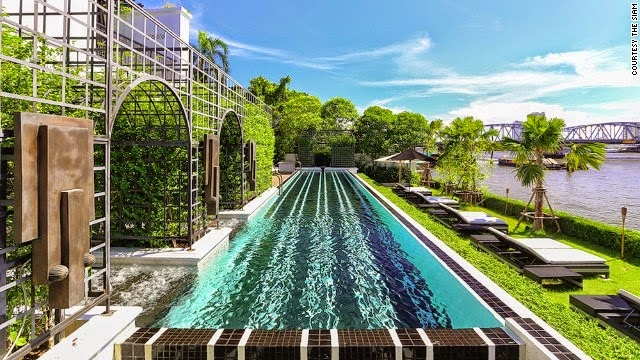
In a city notorious for its traffic, this riverside urban resort offers guests a scenic way to commute -- via converted rice barge from the hotel's private pier on the Chao Phraya River.

You can watch the world float by from a poolside sun lounger next to the river, or better yet, from the private rooftop terrace of the river view pool villa, which also comes with an internal courtyard garden and plunge pool.

With the hotel's art deco design accents, antique collections, a Musee d'Orsay-inspired main building and a restaurant housed in a series of ancient teakwood houses, you'll soon forget you're in the heart of a big, chaotic city.

3. Hotel Molitor (Paris)

Ever since it first opened in 1929 as a public swim and socializing hotspot, this art deco-meets-industrial chic hotel has been synonymous with fab pools.

On a fine summer's day, one can relax by the 46-meter outdoor pool, enclosed by the building's high floors of rooms -- each with porthole windows -- and imagine you're sailing the seas in a luxury cruise liner.

There's also a glass-roofed 33-meter-long indoor pool.

Its pools are so legendary that the main character of "The Life of Pi" (full name Piscine Molitor "Pi" Patel) was named after the place.

A rooftop garden terrace overlooks another Parisian icon, the Eiffel Tower.

4. The Castle Hotel (Dalian, China)

Who would've guessed there's a mountaintop Bavarian getaway just 15 minutes from the CBD of this major Chinese metropolis?

Inspired by Neuschwanstein Castle, once home to Germany's King Ludwig II, the Luxury Collection hotel was originally built in 2002 to house a museum.

Everything about the place is over-the-top.

Statues of Greek gods pepper the magnificent gardens, an extravagant marble lobby features a grand double staircase and opulent chandeliers.

The Yellow Sea views are best enjoyed from the Royal Cellar pub with a frothy pint, or from the 4,850 square foot (450 square meter) indoor heated pool.

5. The Houstonian Hotel (Houston, Texas)

Proving that everything is big in Texas, guests of The Houstonian Hotel enjoy unlimited access to a sprawling 175,000 square foot fitness club, touted as one of the nation's best, and a 17,000 square foot spa.

The hotel is set amongst 18 acres of wooded landscape and has three outdoor pools.

To make your boss question if you even bothered to get any work done, Instagram a photo of the Resort Pool, complete with waterfalls and a slide, or the tranquil Garden Pool, set amongst beautiful landscaping.

The hotel is so relaxing that U.S. former President George Bush Sr. and his wife Barbara made it their official voting residence for more than 10 years.

6. Hotel Santa Teresa (Rio de Janeiro)

Business travelers looking for an alternative base might be tempted to make a beeline to the sexy shores of Copacabana or Ipanema, but for another side of Rio, there's the winding pebbled streets and bohemian neighborhood of Santa Teresa.

The boutique Hotel Santa Teresa was once a colonial coffee ranch. It's since been transformed into a tropical chic property with 40 rooms and suites.

This one's a bit far from Rio's Centro business district -- 40 minutes by car -- but worth the extra commute time.

For the most stunning views in Rio, we recommend heading for the outdoor pool during sunset, which overlooks Santa Teresa Hill, Centro and down to Guanabara Bay.

Caiprinihas optional but highly recommended.

7. The Berkeley (London)

Granted, London's weather might not be ideal for al fresco poolside lounging -- hence the prevalence of subterranean pools -- but on beautiful summer days, nothing beats lounging by the only rooftop hotel pool in the city at The Berkeley.

At 10 by 5 meters, it's not the largest, but the views over Knightsbridge and Hyde Park make up for it.

A selection of poolside light bites and drinks will be enough to tide you over while you top up your tan before your business lunch at the two-Michelin starred Marcus downstairs.

8. The Ritz-Carlton (Singapore)

Situated steps from Marina Bay, this hotel features a 25-meter outdoor pool surrounded by enough tropical foliage that you'd never know you were in the heart of the lion city.

If you'd rather indulge in watery pleasures in the privacy of your own room, there's the butler-drawn bath -- treatments complete with accompaniments (Champagne, strawberries and roses for one, Cohiba cigars and Cognac for another).

Marble bathrooms in the bay view rooms overlook the iconic Marina Bay Sands, the Singapore Flyer ferris wheel and city skyline through exhibitionist-friendly windows.

9. W Santiago (Santiago)

Following the fashionable formula of designer hotels with heavy tints of cool, W Santiago pops with colors and design quirks that will snap you out of suited-and-booted work mode in no time.

You can't escape the Andes, wherever you are in the city, but the contrast of majestic snow-capped peaks and the trendy rooftop pool area on the 21st floor -- bathed in electronic lounge music and shrink-wrapped within the city/mountain panorama -- is as sweet as a year-end bonus.

To include the LED-lit infinity pool in your sights, the so-cool rooftop bar is a great place for a deserving nightcap.


10. Hotel Arts Barcelona (Barcelona)

Aside from being the tallest building in the country, Hotel Arts Barcelona is easily identifiable thanks to a Frank Gehry-designed golden steel installation.

The outdoor pool, set amongst a palm tree-landscaped garden, sits under the shimmering shadow of said fish statue, overlooking the Med.

The recently-launched 43 the Spa offers even better vistas from the sauna room, plus therapies such as a technology-detox treatment to counter the effects of smartphone appendage-itis.

Stay in one of the club rooms and you'll have use of a Smart electric car to make that five-minute drive into the city center for meetings.

11.Villa Kennedy (Frankfurt, Germany)

Unusual for a city residence, this restored former banking family's home features a verdant central courtyard (the "Villa Garden") with a giant oak tree as its centerpiece.

Terraced suites and deluxe rooms overlook over this urban oasis, while over at the serene 1,000 square meter Villa Spa, you can turn off your phone and pretend you're on a luxury wellness retreat as you lounge on the mezzanine relaxation area overlooking the 15-meter Portuguese marble pool.

The hotel is located just 5 minutes from the city center and 10 minutes to the airport, which makes getting back to reality a bittersweet convenience.

Sri Lanka, the teardrop-shaped island that in 2009 emerged from more than a quarter century of civil war, has staked claim as one of Asia's most exciting new destinations.

With the beaches of Negombo and Galle on the West Coast and World Heritage-listed ancient cities, Sri Lanka is experiencing a tourism boom.


As the country's tourism offerings have grown more sophisticated, so have its hotels. Here are a selection of the best.

Reefs Edge

It's only 20 minutes from the capital Colombo, but stand on the balcony of Reefs Edge and you'll feel like you're on a deserted island.

The view of the Indian Ocean is obstructed only by palm trees, affording guests front-row seats to blood red and beautiful sunsets.

A velvet green lawn runs 20 meters from the hotel to the beach, where sun beds and wicker domes beckon layabouts and drinkers of cocktails.

Though it has only 22 suites, Reefs Edge has the look and feel of a large hotel.

Inside, French oak flooring, pastel-colored furniture and open-air bathrooms decked out with rain showers and glass washbasins creating an aura of simple sophistication.

Complete with a day spa, gymnasium, steam room, seafood restaurant and a separate 250-seat banquet hall shaped like Noah's Ark, Reefs Edge takes the edge off a vacation in Sri Lanka.
St. Lachlan

Twenty minutes north of Reefs Edge, Negombo is Sri Lanka's most popular beachside town, thanks to its proximity to the international airport.

Located in a quiet alleyway perpendicular to the main drag, the St. Lachlan is a boutique property with 16 rooms and suites.

The interior speaks colonial cool: it has 10-foot-high doors with giant brass knockers, richly varnished shutters and teak furniture everywhere you look, with antlers and indigenous artwork accentuating the walls.

A riot of giant freshwater prawns, snapper and spices, the seafood platter at Arias, St. Lachlan's poolside restaurant, is among the best in Negombo.

Little wonder -- it's run by Harpo Gooneratne, commonly known as Sri Lanka's first DJ and popular restaurateur.

Heritance Tea Factory

Take Willy Wonka's Chocolate Factory and replace the chocolate with tea. Now convert it into a luxury hotel.

The result is the Heritance Tea Factory, a resplendent four-star hotel set at 2,000 meters above sea level in the rolling green tea-growing region of Sri Lanka's southern highlands.

Latticed with green and red metal and brass, the hotel's museum-like lobby is wallpapered with historic photographs. It's centered around an atrium that houses the factory's original steam engine.

Every evening, this mechanical colossus with its giant gears and camel-hair conveyer belt is turned on for 30 minutes.

The 54 rooms are carpeted and cozy, while the staff, attired in crisp white shirts, bow ties and bell hats, personify the sophistication of the British colonial period.

Jetwing Vil Uyana

Like something out of Luke Skywalker's Tatooine, Sigiriya Rock Fortress is an ancient palace set atop a 200-meter-high natural stone column.

At the rock's base lie a series of pools and cisterns. They're interlinked by an underground conduit network that works as well today as it did when it was built 1,500 years ago.

Matching its sophistication is Vil Uyana, a luxurious ecolodge set in a wetland a 15-minute drive from Sigiriya.

Vil Uyana's 30 chalets feature teak floors, palm-thatch ceilings, Balinese bathrooms and woven reed wall hangings.

Edging a mauve green lake brimming with birdlife, the swimming pool and lobby lead to a colonial-chic restaurant upstairs bookended by six-meter-high stone walls that are a nod to Sigiriya's ancient architects.

Palagama Beach

In 2008, while visiting his father's family in Colombo, British advertising executive John Balmond snuck off for the weekend to the Kalpitiya Peninsula a two-hour drive to the north.

He stayed in a banana-leaf bungalow, one of three accommodation properties on the lush, palm-fringed finger of land that divides the Puttalam Lagoon from the Indian Ocean.

Today there are 42 properties on the peninsula, including Palagama Beach, owned by Balmond and designed by Cecil Balmond (designer of London Olympics Orbit).

Set on a grassy parcel of land on the beach, the property features 14 generously spaced cabanas and villas that blend modern amenities, luxury touches and village style.

Other highlights include an infinity-edged pool, a restaurant and a banana-leaf bar/moonlight cinema.

Pledge3

Sri Lanka's most sophisticated hotel is Pledge3, a five-star oasis of luxury and retro style in busy Negombo.

Every corner of this boutique hotel screams cutting edge design.

The 12 suites are spread across two floors surrounding an internal flagstone courtyard.

The third floor is home to two apartment-size attic suites featuring executive work stations, private terraces and glass-encased bathrooms outfitted with his and her washbasins, egg-shaped bathtubs and presidential toilet bowls (whatever that means).

The courtyard leads to an open-air restaurant where the decor -- cherry red support beams and white leather couches -- is as eccentric as the Japanese-Sri Lankan-Mediterranean fusion menu.

Beyond it lies a tropical garden centered by a saltwater pool where attendants with the reflexes of Wimbledon ball boys attend to guests' every beck and call.